柔の道
Breathe by Rickson Gracie: what's actually useful
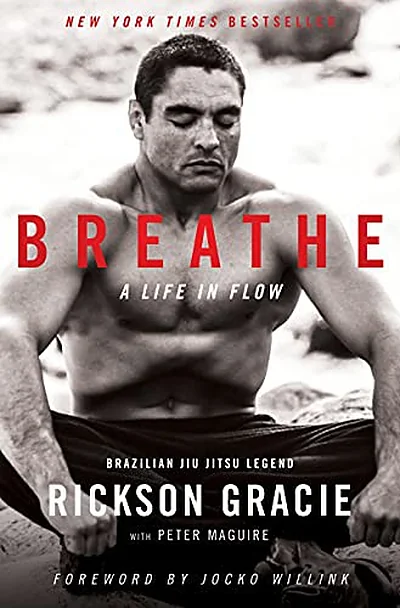
Breathe: A Life in Flow is the memoir of Rickson Gracie, widely called the most feared fighter the Gracie family produced, written with the historian Peter Maguire. It is part life story, part fighting philosophy, and it spent time on the New York Times bestseller list. For a beginner it is worth reading, but not for the reasons the cover promises. The useful parts are quieter than the legend, and a few of the loud parts are worth doubting. Here is how to read it.
The one idea a beginner should take: breathing is a skill
The title is not a metaphor. The most practical thread in the book is that Rickson treated breathing as trainable, the way you would train an armbar. He credits much of it to the yoga teacher Orlando Cani, whose method, bioginástica, paired movement with deliberate breath. The claim underneath is simple and true: when you are tired or scared, your breathing falls apart first, and when your breathing falls apart, your technique follows.
On the mat the difference between surviving a hard round and gassing out in two minutes shows up fast. A beginner being crushed in side control does not need a new escape half as much as they need to stop holding their breath. Try the cue directly. When the weight settles on you, breathe out slowly through the pressure instead of bracing against it. Take a small breath, then start your escape on the next exhale, the moment your trunk un-braces and your hips are free to move. Off the mat, the book's implicit homework is a minute or two of slow nasal breathing a day, the exhale longer than the inhale, until calm breathing under load is a habit and not a hope. The learning to breathe post drills the mechanics; Breathe is the case for making them a daily practice.
Flow over force: the efficient game
The subtitle, "a life in flow," points at the second usable idea. Rickson's jiu-jitsu was never about being the strongest man in the room. It was about staying connected to an opponent, feeling where the weight went, and spending energy only when it paid. Beginners burn out because they treat every roll as a fight to win right now, muscling every grip.
The book's version of flow turns into three habits a beginner can start this week. Stay relaxed until you actually need force, gripping firmly and leaving everything else loose. Stay heavy through your hips instead of pushing with your arms: when you are the one on top, settle your hips onto the point where you meet them and drive off your legs, not your hands, so the other person carries your weight and tires first. And wait for the opening rather than forcing one, spending a real burst of effort only when a gap appears. None of that is mystical; it is the same efficiency behind frames, not strength, described by a man who beat bigger opponents for a living.
Where to doubt Breathe
A memoir by a fighter is not a physiology textbook, and Breathe is at its weakest where it sounds most certain. The breath mystique the book builds spills into the large public claims Rickson has made about breath control, and some do not survive contact with expert scrutiny: the freediving instructor Gert Leroy publicly picked apart Rickson's podcast claims about hyperventilation and breath-hold times, noting that trained freedivers hold their breath far longer without the theatrics. Take the breathing as a tool for composure and conditioning, which it genuinely is, and leave the superhuman version on the shelf.
The family history needs the same care. A memoir is memory, and memory and record do not always match: Bloody Elbow's review found a narrator whose self-portrait contradicts itself, prouder of his humility than humble, and sharper on other people's failings than his own. Rickson tells the Gracie story from the inside, which is moving and also partial. Where his version and the documented history differ, the record is the safer guide. The academy that made the name is covered in the Gracie academy and the building of a name, and the disputed early transmission of the art in Belém and the disputed transmission. Read Breathe alongside them, not instead of them.
Who it is for
If you want drilling instructions, look elsewhere; the book teaches almost no technique. If you want to understand why a calm, breathing, patient game beats a frantic strong one, and you do not mind a great fighter telling his own legend, it delivers. Read it for the mindset, borrow the breathing, and keep your historian's eye open.
You can find Breathe: A Life in Flow on Amazon.
Questions readers ask
Is Breathe by Rickson Gracie worth reading for a beginner?
Yes, if you buy it for mindset rather than moves. There is essentially no technical instruction in it. What you get is a persuasive case for two habits that quietly decide your first year: breathing on purpose so composure survives fatigue, and choosing a loose, connected, patient game over a strong and frantic one.
What is the main lesson of Breathe?
That breath is the foundation of everything else. Rickson argues that calm, deliberate breathing is what lets skill survive fatigue and fear, in a fight and in life. The book's "flow" is the same idea applied to movement: stay connected, stay efficient, and spend force only when it pays.
Are Rickson Gracie's breathing claims accurate?
Partly. The core idea, that trained breathing improves composure and conditioning, is sound and useful. Some of his bigger public claims about breath-hold times and hyperventilation have been publicly disputed by a freediving instructor, so treat the memoir as motivation rather than physiology.
Is Breathe a good history of the Gracie family?
It is a good story told from the inside, but not a reliable history. Rickson writes from memory and loyalty, his self-portrait sometimes contradicts itself, and his version occasionally differs from the documented record. For the history, cross-check it against sourced accounts of the family and the early art.
This is a beginner's journal, not instruction. Nothing here is training, health, or medical advice. Learn from a qualified coach, and tap early. Disclaimer