柔の道
Jiu-jitsu vs Luta Livre and the 1991 Desafio
The Gracie name was made in the ring as much as in the classroom. From the 1930s the family issued open challenges in the Rio newspapers, inviting a fighter of any style to test himself against a Gracie with almost no rules. Those fights had a name: vale tudo, "anything goes." For half a century it was where jiu-jitsu went to prove it was not a bluff, and the proving was not always clean or kind.
Vale tudo, the proving ground
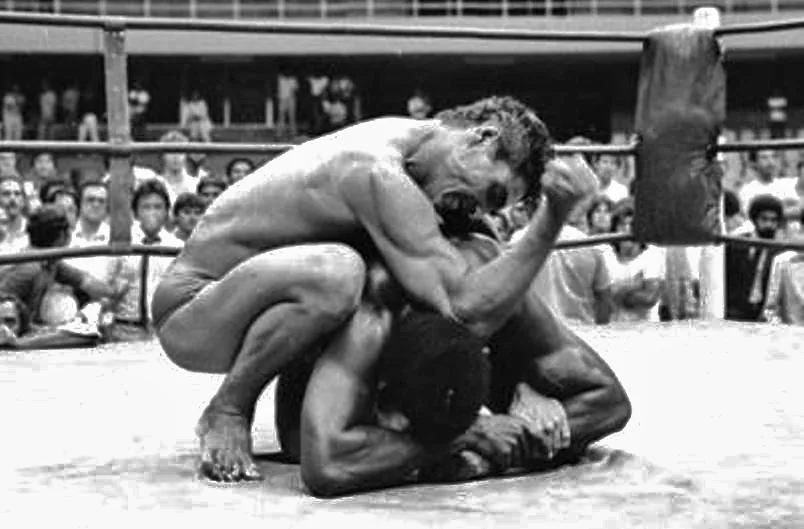
Vale tudo was Brazil's bare version of a real fight: striking and grappling together, few rules, often no time limit. It is the direct ancestor of modern mixed martial arts, and for decades it was the crucible the Gracies fought in to build their reputation. The art that won there was not the prettiest. It was the one that could take a stranger to the ground and finish him, and jiu-jitsu, with its patient ground game, kept doing exactly that. Rickson Gracie built part of his legend in these bouts, twice beating the brawler Rei Zulu before big crowds.
What is Luta Livre?
Jiu-jitsu was never the only grappling art in Brazil. Luta Livre, "free fighting," grew up beside it: a style fought without the gi, with roots in catch wrestling, the pin-and-submit Western style that spread through carnivals and prize rings. The two became bitter rivals. The bad blood ran back to the early 1940s, when Euclydes "Tatu" Hatem, a foundational figure of Luta Livre, beat George Gracie in a match Luta Livre would not let the family forget. The rivalry carried an edge that was not only about technique. Luta Livre needed no gi and no expensive academy, and it drew from outside the world the Gracie name moved in, so the feud became partly a question of who Brazilian grappling belonged to. By the late 1980s it had spilled off the mats and onto the sand, most famously in 1988, when Rickson Gracie and the Luta Livre fighter Hugo Duarte fought on Pepê Beach in front of a crowd.
The 1991 Desafio: jiu-jitsu vs Luta Livre
It came to a head on 26 September 1991, at the Grajaú Country Club in Rio, in an event billed as the Desafio, jiu-jitsu against Luta Livre, broadcast live on Rede Globo. Five bouts were announced and two never happened. Marco Ruas, widely seen as the best fighter Luta Livre had, pulled out, which gave Amaury Bitetti a walkover, a win without a fight. An injury in training to Marcelo Behring handed Hugo Duarte the billed main event the same way. That left three fights actually contested: for jiu-jitsu, Wallid Ismail, Murilo Bustamante, and Fábio Gurgel, drawn from more than one academy; for Luta Livre, Eugênio Tadeu, Marcelo Mendes, and Denílson Maia. Jiu-jitsu won all three, every one by stoppage, and none of them was an elegant submission. Gurgel took the mount and finished with punches. The other two ended with the Luta Livre fighter on the floor outside the ring and unable to come back in.
| Jiu-jitsu | Luta Livre | How it ended |
|---|---|---|
| Wallid Ismail | Eugênio Tadeu | TKO, about sixteen minutes in |
| Murilo Bustamante | Marcelo Mendes | TKO, under five minutes |
| Fábio Gurgel | Denílson Maia | Mount and ground strikes, under ten minutes |
Of the fights that happened, it was a shutout. Luta Livre never regained the claim to parity it had walked in with, and jiu-jitsu stood, in Brazil at least, as the grappling art that had answered every challenge put to it.
Why jiu-jitsu won the Luta Livre rivalry
The fighting years are where jiu-jitsu earned the reputation the rest of the world would later take for granted. Both arts took the fight to the ground, so the real difference was in what they did once there. Jiu-jitsu had built a whole system around position: how to fight from your back in the guard, how to escape a worse spot, how to climb from guard to mount to the back, and how to keep the submission for last. Luta Livre, out of catch wrestling, was dangerous on top and quick to the legs, but it had spent less time on the harder problem of fighting from underneath. With few rules and nothing to be won on points, that gap decided fights: the jiu-jitsu man could stay safe under a stronger opponent, wait out the danger, and work his way to a position where the finish was his to take. On the night in 1991 it showed up in its plainest form: jiu-jitsu got on top and stayed there.
By then jiu-jitsu had met the styles Brazil could put in front of it, in the newspapers, in the vale tudo ring, and against its closest rival, and it had mostly won. The one thing left was to prove it somewhere the rest of the world was watching. That stage would be built out of a garage in California, and by the end of 1993 it had a name: the Ultimate Fighting Championship.
Questions the record raises
Who won, jiu-jitsu or Luta Livre?
Jiu-jitsu. In the decisive 1991 Desafio, the jiu-jitsu team won all three contested fights, every one by stoppage. The result broke Luta Livre's claim to parity and left Brazilian jiu-jitsu as the country's dominant grappling art. The bad blood did not vanish, though. It erupted again in 1997, when the crowd rioted at a Renzo Gracie versus Eugênio Tadeu fight in Rio, the bout was ruled a no contest, and vale tudo events were banned in the city for a time.
What is Luta Livre?
Luta Livre, "free fighting," is a Brazilian submission-grappling art fought without the gi, with roots in catch wrestling. It grew up alongside Brazilian jiu-jitsu and became its main rival. Because it needed no gi and no expensive academy, Luta Livre drew heavily from the working class, a difference the histories treat as giving the rivalry a lasting class edge.
What is vale tudo?
Vale tudo, Portuguese for "anything goes," was Brazil's bare contest of striking and grappling with almost no rules and often no time limit. It was where fighters tested which style actually worked, and it is the direct ancestor of modern mixed martial arts. The Gracie family built much of its early reputation in vale tudo matches.
Why did jiu-jitsu beat Luta Livre?
Both arts fought on the ground, so the edge was in the details. Jiu-jitsu's system of position, fighting from the guard and advancing step by step before finishing, let its fighters survive the exchanges, get on top and stay there, where Luta Livre's catch-wrestling game had less to answer with. In the 1991 Desafio no Luta Livre fighter found a reply. The win was less about one style being better in the abstract than about what held up when the rules disappeared.
Is Luta Livre still practiced today?
Yes, though it is far smaller than Brazilian jiu-jitsu. Its fighters shaped early vale tudo and the first years of the UFC, and the art still has practitioners and gyms, especially in Brazil and Europe. Much of its no-gi grappling has also flowed into modern mixed martial arts, where the old gi-versus-no-gi divide matters far less.
When was the Desafio?
The main Jiu-Jitsu vs Luta Livre Desafio was held on 26 September 1991, at the Grajaú Country Club in Rio de Janeiro, and broadcast live on Rede Globo. It followed years of challenge matches and beach confrontations between the two camps, and its one-sided result is the moment most often cited as the end of the rivalry.
This is a beginner's journal, not instruction. Nothing here is training, health, or medical advice. Learn from a qualified coach, and tap early. Disclaimer