柔の道
Warrior Mindset by Roger Gracie: what a beginner can use
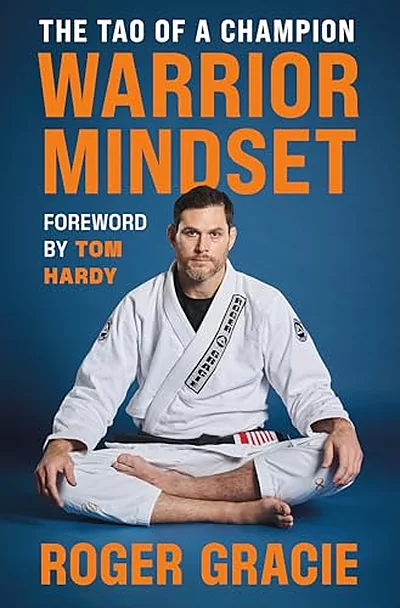
Warrior Mindset: The Tao of a Champion is Roger Gracie's account of the mind behind ten IBJJF world titles at black belt between 2004 and 2010, by a grandson of Carlos Gracie widely regarded as the greatest gi competitor jiu-jitsu has produced. St. Martin's Press published it in 2025 with a foreword by the actor Tom Hardy, who trains at one of Gracie's academies and has competed. Part memoir, part philosophy, it is built on four lessons: learning to breathe, controlling your emotions, mastering your thinking, and developing quiet inner grace. A nervous beginner should read it with a sorting rule in hand. Gracie's problems are not your problems, but his nerves are your nerves. Keep what is universal, and enjoy the rest as spectacle.
Fear is not a disqualification
The book's spine is the claim that calm is trained, not issued at birth. Its best material surrounds the 2017 superfight against Marcus Buchecha Almeida, the rival who had matched his world title count. Roger came out of retirement to face a man he describes as nine years younger and sixteen kilos heavier, said a loss would have left him "forever considered number two," and called it "probably one of the biggest challenges I had, mentally getting to that fight." He won by collar choke. He frames the book's whole subject the same way: facing the voice that says a thing is too dangerous, and finding what pushes you through.
A beginner hears a smaller version of the voice before every class, and the book's answer transfers directly: fear is information that the thing matters, not an instruction to stop, and the reply is a routine, not an argument. Build a pre-roll ritual and keep it identical. Arrive early, same warm-up every time. Before the slap and bump, take one slow exhale through the nose and let your shoulders drop with it. Then give the first minute exactly one job, breathe and survive, nothing else. The voice does its best recruiting off the mat, running the same pattern the quitting post maps in month two. Breath as a trainable skill is the heart of book one in this series; Warrior Mindset assumes it and builds the emotional layer on top.
Do the known thing until nobody can stop it
Roger's game was famously plain. The techniques that won his biggest matches are taught in every fundamentals class: a mounted cross choke ended his 2006 world final against Robert Drysdale, and a collar choke ended the Buchecha match eleven years later. Opponents knew what was coming and could not stop it. The book's tao, the quiet grace and the mastered thinking, is the inner face of that simplicity: fewer techniques means fewer decisions, made better, under less panic.
The transferable practice is depth on purpose. Pick one technique for each position you actually reach, three or four in total, and make the short list your only project for a month. Steer every roll toward it. When your escape fails, resist the reflex to learn a different escape; name the detail that failed, ask your coach about only the detail, and drill only the fix. Count attempts rather than wins; depth is measurable where novelty is not, and the count becomes the kind of invisible marker the progress post teaches you to read.
Where to doubt Warrior Mindset
A champion's memoir is not a psychology manual, and reception outside the sport has been cooler than inside it. One Goodreads reviewer describes a book that meanders across autobiography, motivation, and self-help without staying anywhere long enough to go deep; another calls the personal-growth sections a remix of classic self-help, and several more find it unfocused. One jiu-jitsu blog's review praises exactly the same mixture, reading it as part autobiography, part philosophy, part guide to living. Both readings fit: the closer you already are to the mats, the more the stories carry the advice.
The second doubt is scale. The pressures the book resolves are champion pressures, a legacy on the line in front of an arena. A beginner's fear is about embarrassment and survival, not legacy, so the lessons need translating, and the book does not always translate for you. The applications above are that attempt. Third, expect no technique: the publisher's pitch is wisdom from a fighting career, and the four lessons are compass headings, not drills.
Who it is for
If you need proof that fear visits everyone on the mat, including the man with ten world titles, the book delivers with unusual credibility, plus an argument for simple, deep jiu-jitsu a first year can borrow whole. If you want technical instruction, or you have already read a shelf of performance psychology, the familiar parts will outnumber the new ones. Read it for the calm, and keep the sorting rule handy.
You can find Warrior Mindset: The Tao of a Champion on Amazon.
Questions readers ask
Is Warrior Mindset by Roger Gracie worth reading for a beginner?
Yes, with the right expectations. It contains no technique. Its value for a first-year student is a credible case that nerves are normal equipment, made by a ten-time world champion who says that mentally getting to his defining match was probably one of its biggest challenges, plus an argument for a small deep game over collected moves.
Does Warrior Mindset teach jiu-jitsu techniques?
No. It is a memoir and a philosophy organized around the publisher's four lessons, from learning to breathe through controlling your emotions and mastering your thinking to developing quiet inner grace. The book supplies reasons and stories, not method.
How many world titles does Roger Gracie actually have?
Ten IBJJF world championships at black belt between 2004 and 2010, with double gold in weight and absolute in 2007, 2009, and 2010. He also won both divisions at the 2005 ADCC while submitting all eight opponents, and came out of retirement in 2017 to submit Marcus Buchecha Almeida.
What is the main lesson of Warrior Mindset?
That calm under pressure is a trained response rather than a personality trait. Gracie pairs trained composure with radical simplicity, so that under the worst pressure there are fewer decisions left to get wrong.
What are the criticisms of Warrior Mindset?
Reader reviews on Goodreads find it unfocused, drifting between memoir, motivation, and self-help, and one finds the personal-growth sections repetitive for readers who know the genre. Coverage from inside jiu-jitsu has been warmer. Treat it as a champion's memoir with a mental curriculum attached, not a psychology manual.
This is a beginner's journal, not instruction. Nothing here is training, health, or medical advice. Learn from a qualified coach, and tap early. Disclaimer