柔の道
What jiu-jitsu became: sport, self-defense, and who owns it
After 1993 the art no longer had to prove that it worked. It had a harder question to answer instead: what was it now that everyone knew? The story of the last three decades is the art figuring out what to be, and discovering that becoming famous does not settle anything. In that time it became three things at once: a global sport, a self-defense system, and an art with no single owner.
It became a sport
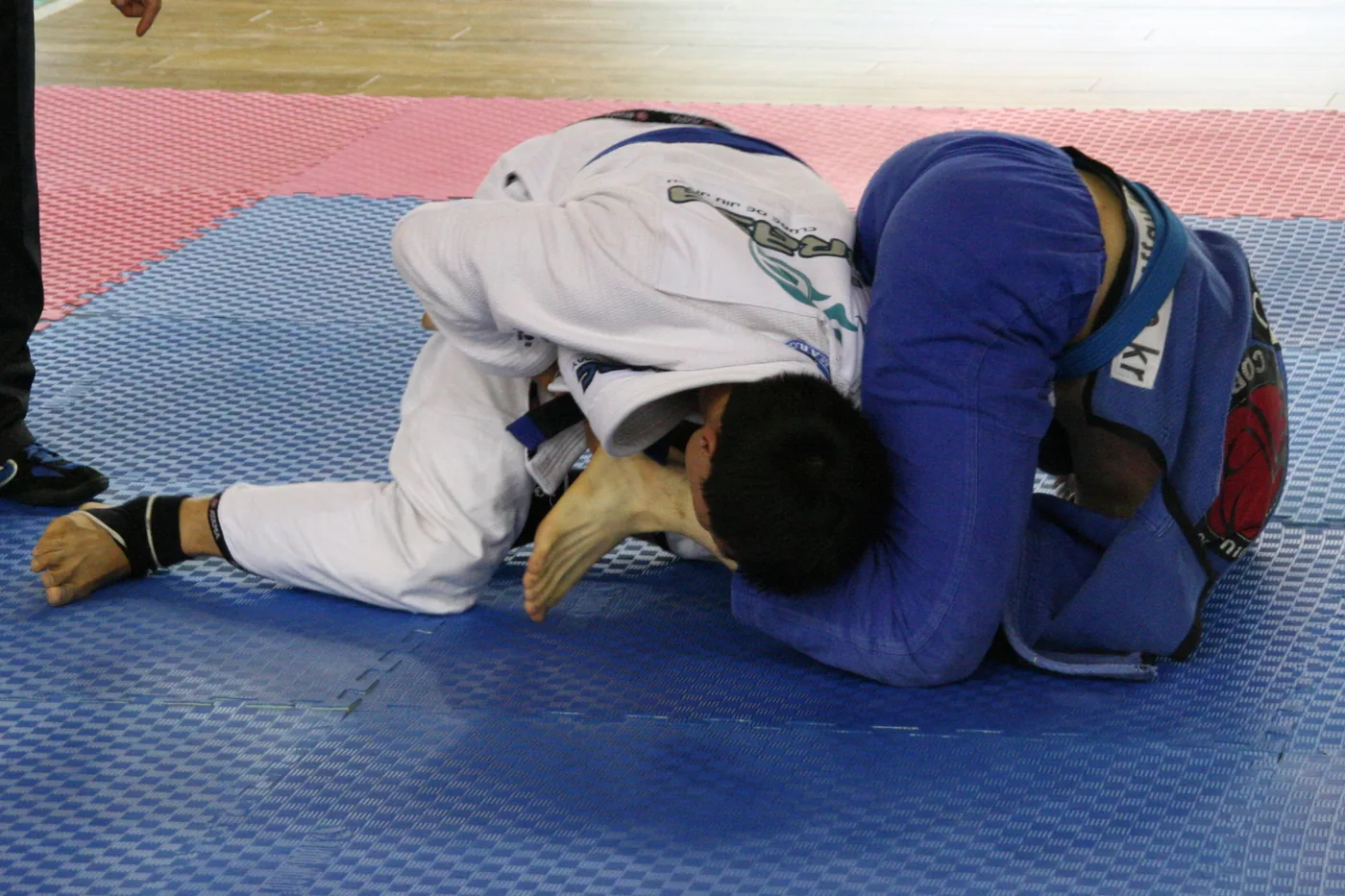
The first thing it became was a competition. In 1994 Carlos Gracie Jr. founded the federation that would become the International Brazilian Jiu-Jitsu Federation, to organize the belts and the rules, and it held the first World Championship in 1996. A separate submission-grappling event, the ADCC, began in 1998 for matches without the gi. Points, medals, weight classes, and world champions followed. Within a generation jiu-jitsu went from a family's guarded method to a fast-growing global sport, with gyms in nearly every city and vast numbers of people training who will never have a street fight in their lives. The belt that once marked a fighter's readiness came to mark something quieter as well: years of patient practice, handed out slowly, a measure of devotion as much as of danger.
The sport versus self-defense argument
The moment it became a sport, an old complaint returned. People began to ask whether the competition had drifted from the fight, whether a game of points and grip-fighting had wandered away from the self-defense the art was built for. That worry is not new, and it is not even Brazilian. It is almost word for word the argument Kanō made against Kosen judo in 1926, that a sport can quietly grow away from the thing it was meant to be. The art that judo produced inherited judo's own family quarrel, and it has never resolved it. It probably never will, and that may be a sign of health rather than sickness.
It stopped belonging to anyone
The last thing the art became is the hardest to sell and the truest. It stopped belonging to anyone. Not to the family that built its name, not to Brazil, not to Japan, where a different version had already gone its own way. The same art now lives in a Rio academy, a California garage grown into a franchise, a dojo in Tokyo, and a strip-mall gym in a town none of the founders could have found on a map. Everyone who trains owns a piece of it, and no one owns the whole.
Which is where a history like this one honestly ends, and where it quietly keeps beginning. Not with a single hero or a clean bloodline, but with a beginner tying a white belt for the first time, stepping onto the mat, and joining a story that was never one person's to own. That beginner is the reason this site exists, and the reason the story was worth telling straight.
This is a beginner's journal, not instruction. Nothing here is training, health, or medical advice. Learn from a qualified coach, and tap early. Disclaimer